
The $3-per-month hosting plan looks like an obvious bargain, and picking it feels like a reasonable decision at the moment you make it — the direct savings are real, the marketing is persuasive, and the affiliate content ecosystem is full of articles telling you it’s plenty for a serious business site. What almost none of that content honestly discusses is the total cost picture. Cheap hosting’s real cost isn’t the invoice; it’s the lost revenue from slow pages, the cleanup bills from security incidents, the time wasted on problems better hosting would prevent, the SEO ranking losses that compound over years, and the eventual migration cost when the site outgrows what the cheap tier can deliver. Once you honestly total all of these, the “cheap” hosting frequently ends up being the most expensive option across the three-year window that actually matters.
This guide is the version of the cheap-hosting analysis you don’t get from the affiliate reviews. We have migrated dozens of client sites off cheap hosting over the years, and the pattern of hidden costs is remarkably consistent. If you want the broader context of how hosting sits within ongoing website care and total cost of ownership, our complete website maintenance guide is the wider reference. This article focuses tightly on the seven categories of hidden cost cheap hosting produces, how to recognise the ones you’re already paying, and how to move to hosting that actually costs less across the full picture.
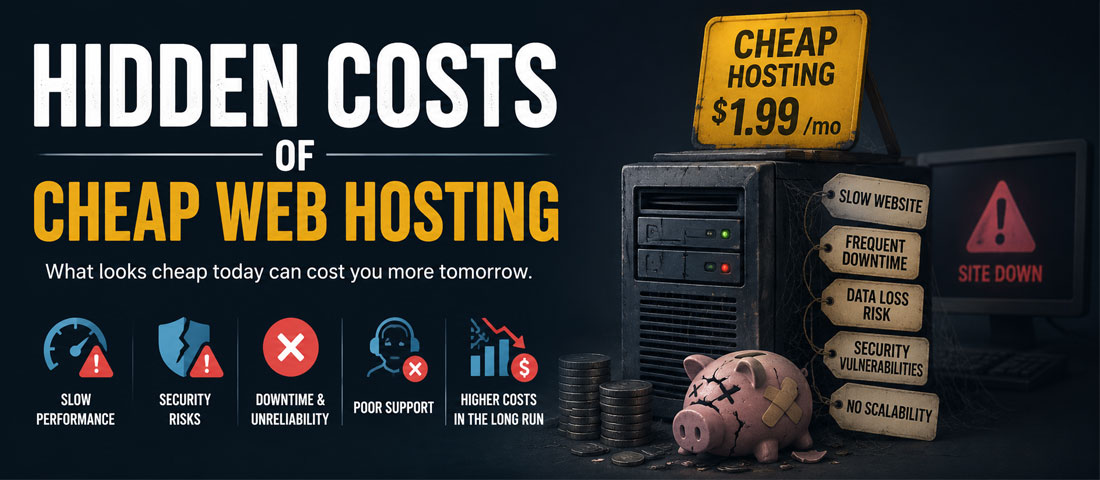
Before dissecting the hidden costs, it’s worth being honest about why cheap hosting is so consistently the default choice. The economics are seductive in specific ways that make the decision feel rational even when it isn’t producing rational outcomes.
The visible price is genuinely low — $3 to $10 per month for basic shared hosting, often marketed with introductory rates as low as $2.99. Compared against quality hosting at $30-50 per month, the annual difference looks like $300-500, which feels like real money for a small business trying to control costs. This comparison is what most hosting review content leads with, because it’s what drives affiliate revenue and matches how small business owners naturally think about budgets.
The comparison is misleading because it only measures one dimension. Yes, cheap hosting saves $300-500 in direct fees. What the comparison ignores is what those savings cost you across the seven categories this article dissects — lost revenue, downtime, security incidents, wasted time, SEO penalties, backup gaps, and eventual migration. When these are honestly counted, the total cost of cheap hosting frequently exceeds the total cost of quality hosting by significant amounts, often by factors of 2-3x when the site is a serious business asset. The comparison you’re actually making isn’t “$36 per year vs $360 per year”; it’s “the true total cost of the cheap path vs the true total cost of the quality path” — and the true total costs look very different from the invoice numbers.
The other reason cheap hosting keeps getting chosen is that most of the hidden costs are individually small enough to be attributed to other causes. Slow pages get blamed on your images. Occasional downtime gets blamed on random internet issues. Security incidents get blamed on WordPress plugins. The pattern that all of these are connected — that the underlying hosting is producing multiple symptoms that individually look unrelated — is only visible in retrospect after you’ve moved to hosting that doesn’t produce them. Businesses on cheap hosting rarely see it clearly while they’re on it.
Understanding what makes hosting cheap explains why the hidden costs exist. The specific cost-cutting measures cheap hosts use are what produce the outcomes that end up costing you elsewhere.
Massively oversold shared servers. A quality shared host might put 50-100 customer sites on a single physical server. A cheap host puts 500-2000 sites on the same hardware. The math of “unlimited” hosting only works because most customers use minimal resources, but this means the moment any of them use meaningful resources, everyone else’s performance degrades. Your slow site isn’t a coincidence; it’s the direct product of sharing a server with thousands of other sites.
Aggressive resource throttling. Cheap hosts limit how much CPU, RAM, and I/O any individual customer can use, and throttle sites that exceed the limits — often silently. Your WordPress site running fine at 3am becomes slow at 2pm because you’ve hit throttling limits during your traffic peak. The throttling itself is often invisible to the customer, showing up only as unexplained slowness at specific times.
Older PHP and outdated software stacks. Cheap hosts often run PHP 7.4 or older when PHP 8.2+ is the current standard, because upgrading customer sites across a large customer base is operational cost the host would rather avoid. Older PHP is meaningfully slower and has security vulnerabilities that current versions don’t. Your site running on old PHP is slower and less secure than it would be on modern hosting, purely because of the host’s operational choices.
Traditional HDD storage rather than SSD or NVMe. Some cheap hosts still use spinning disk storage, which is dramatically slower than solid-state alternatives for the database queries and file operations web applications rely on. The performance gap between HDD and NVMe is significant enough that the same site on the same software stack can perform 3-5x differently depending purely on the underlying storage.
Minimal support infrastructure. Quality hosts staff support teams. Cheap hosts route support through automated ticket systems, chatbots, and outsourced first-tier operators who follow scripts. When something breaks, the support experience on cheap hosting is designed to minimise the host’s cost, not to solve your problem quickly.
Feature limits that force workarounds. Cheap hosts limit database connections, PHP execution time, memory limits, cron jobs, and other technical parameters below what serious sites need. You end up building workarounds around the platform’s limitations rather than doing the work you’d otherwise do. Each workaround has a cost even when it’s not directly visible.
The most measurable hidden cost is revenue you never earn because your slow site converts poorly. The relationship between page speed and conversion is well-documented across the industry, and the numbers translate directly to lost income on cheap hosting.
Conversion rates drop meaningfully as page load time increases. Research from multiple sources (Google, Amazon, Deloitte, and others) consistently shows that conversion rates fall roughly 4-7% for every additional second of page load time. A site converting at 3% at a 2-second load time converts at roughly 2.7% at a 3-second load time and 2.4% at 4 seconds. The difference between a 2-second load site and a 4-second load site is often 20-30% of total conversions — meaning cheap hosting that produces 4-second loads is quietly costing you a fifth or more of the revenue you’d otherwise earn.
The math on a typical small business site makes this concrete. A site producing $10,000 monthly revenue at 4-second loads would produce roughly $12,000-13,000 at 2-second loads. That’s $24,000-36,000 per year in unearned revenue. Against $300-500 per year in hosting savings from choosing cheap over quality, this is a terrible trade. The savings are real, but they represent a tiny fraction of what the slowness costs you.
The specific mechanism is that shared hosting produces variable Time to First Byte (TTFB) that puts a ceiling on total page speed regardless of what else you do. A site with a 500-800ms TTFB on cheap hosting cannot achieve the sub-2.5-second Largest Contentful Paint that Google now expects for good ratings, no matter how well the rest of the site is optimised. The full mechanism is explained in our piece on why your website is slow and it’s probably your hosting, but the short version is that TTFB is the floor for everything else, and cheap hosting produces high TTFB structurally.
Cheap hosting produces more downtime than quality hosting, and the downtime costs money in ways that never appear on any invoice.
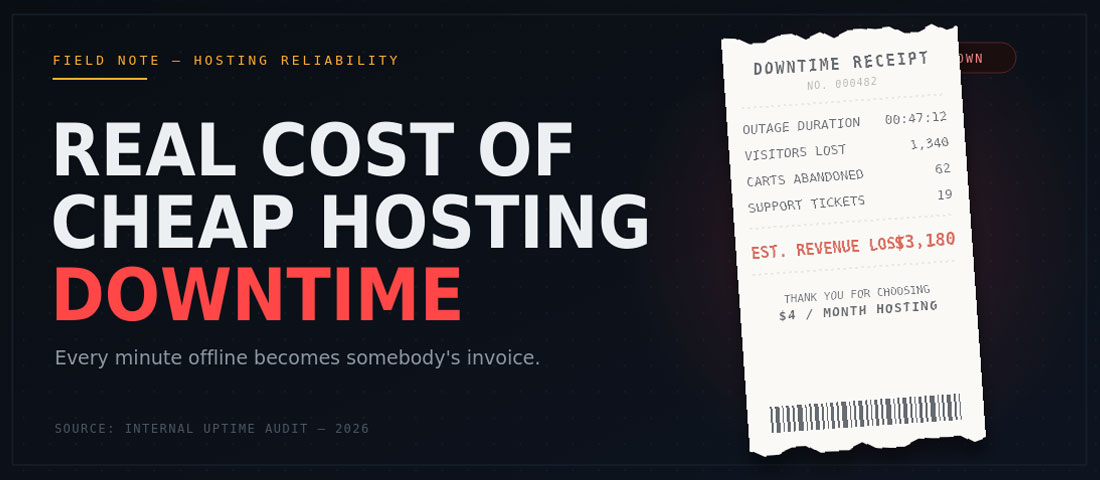
Uptime marketing is universally misleading. Cheap hosts advertise 99.9% uptime targets but realistically deliver 99.5-99.8% in practice. Quality hosts deliver genuine 99.9% or better. The difference sounds small — 0.4% — but translates to meaningful downtime. 99.9% uptime is 43 minutes of downtime per month. 99.5% uptime is 3.5 hours per month. Over a year, that’s 8 hours versus 42 hours — a factor of 5x more downtime.
The revenue impact of downtime depends on your business but is rarely zero for any commercial site. An eCommerce site down for 3.5 hours per month loses the sales that would have happened during those hours plus the reputation damage from customers who tried to buy and couldn’t. A lead generation site loses leads that don’t return. A service business loses appointment bookings, contact form submissions, and inquiries. Even sites without direct transactional revenue lose the visitors who arrive during downtime and don’t come back.
The “we didn’t know we were down” problem compounds this cost. Cheap hosting rarely includes monitoring that alerts you to downtime; you discover outages when customers complain or when you happen to visit the site yourself. Downtime that lasts hours before anyone notices costs disproportionately more than downtime caught immediately, because the compound effect on trust and abandoned purchases grows with duration.
For a business with $10,000 monthly revenue where organic search drives 40% of traffic, 3.5 hours of monthly downtime translates to roughly $50-200 in direct lost revenue per month depending on when the downtime occurs. Over three years, that’s $1,800-7,200 in downtime-attributable losses that quality hosting would have prevented.
Cheap hosting is fundamentally less secure than quality alternatives, and the cost of security incidents shows up in ways businesses don’t anticipate.
Shared IP reputation damage. Your cheap hosting IP address is shared with hundreds or thousands of other sites. When any of them get compromised, sends spam, or triggers Google Safe Browsing warnings, your site’s reputation suffers by association. Email deliverability drops because your IP is on shared blacklists. Search visibility drops because Google’s trust in the IP falls. You didn’t do anything wrong, but you’re paying the reputation cost of the least trustworthy site sharing your infrastructure.
Neighbour compromise effects. Some cheap hosts have limited isolation between customer accounts, meaning a compromise on a neighbour site can potentially reach yours through server-level vulnerabilities. This is less common than it used to be but still occurs on the cheapest tiers. Your security posture is only as strong as your weakest neighbour, and on cheap shared hosting, the weakest neighbour is unavoidably weak.
Malware cleanup costs. When a site gets compromised, the cleanup process typically costs $200-2,000 for professional service depending on complexity — significantly more than the hosting savings that led to the vulnerability in the first place. If the compromise damages search rankings, the recovery cost extends further as SEO work is required to restore visibility.
Google Safe Browsing warnings. When Google flags a site as unsafe (which can happen through no fault of your own if you’re on compromised shared infrastructure), the warnings displayed to visitors are catastrophic to conversion — most visitors leave immediately rather than proceed. Getting the flag removed requires cleanup and reverification, which can take days to weeks depending on the severity.
SEO recovery after security incidents. Security incidents that damage search visibility require ongoing SEO work to recover. Rankings that took years to build can drop within weeks of a security event, and recovery typically takes months of dedicated effort. The compound revenue impact of ranking losses from security incidents often dwarfs the direct cleanup cost.
These security-related hidden costs are not hypothetical. They occur on shared hosting significantly more often than on quality hosting, and when they occur, the total cost typically exceeds several years of hosting savings.
Cheap hosting produces a stream of small problems that consume time — support tickets, workarounds, debugging, and manual intervention that better hosting simply doesn’t require.
The support experience is where this shows up most directly. Cheap host support tickets typically take 24-48 hours for first response and multiple rounds to resolve. Quality host support responds within an hour and resolves most issues on first contact. If you deal with even one support issue per month, cheap hosting is consuming 2-5 hours of your time per issue that quality hosting would consume 30-60 minutes. Multiply across the year, and you’re spending 20-50 hours dealing with hosting-related friction that better hosting would eliminate.
Performance debugging follows the same pattern. Sites on cheap hosting produce intermittent slowness that customers report and that you can never quite figure out. You spend hours running speed tests, comparing metrics, checking plugins, and trying to isolate the cause — when the actual cause is the hosting itself producing variable performance. The debugging time is real cost even when it doesn’t feel like it, because it’s time you’re not spending on business activities that generate revenue.
Platform limit workarounds are the least visible time cost. Cheap hosting’s tight limits on database connections, PHP execution time, memory, or cron jobs force you to build workarounds — splitting operations into smaller chunks, using external services for tasks the host won’t allow, avoiding features your CMS supports. Each workaround takes time to implement and adds complexity that costs more time to maintain.
For a business owner whose time has any commercial value, these hidden time costs add up substantially. Even valuing the time conservatively at $50 per hour, spending 30 hours per year on hosting-related friction represents $1,500 in opportunity cost — several times the direct savings from cheap hosting choices.
Cheap hosting damages SEO through multiple mechanisms, and the compound revenue effect over years is significant enough to dwarf almost every other hidden cost combined.
Core Web Vitals are direct ranking signals, and cheap hosting cannot produce good Core Web Vitals reliably. The Largest Contentful Paint threshold Google uses (2.5 seconds) is genuinely unreachable on sites where TTFB alone is 500-800ms. Sites that fail Core Web Vitals lose rankings to competitors whose hosting supports them, and the loss compounds because lower rankings produce less traffic which produces fewer engagement signals which produces further ranking losses.
Server response time is a distinct ranking factor beyond Core Web Vitals. Google’s algorithms specifically weight fast-responding servers over slow ones for the same content quality. Cheap hosting produces slow, variable server responses that lower your ranking ceiling regardless of what other SEO work you do.
Uptime affects rankings over time as well. Frequent brief outages, even ones that don’t hit user awareness, damage the crawl statistics Google uses to assess site reliability. Sites that Google can’t reliably crawl fall behind sites it can crawl consistently.
The compound revenue impact of these SEO penalties over three years is where the true cost of cheap hosting reveals itself. A site that would have grown to 10,000 organic visitors per month on quality hosting might plateau at 4,000 on cheap hosting because of the ranking ceiling. Multiply the lost visitors by average conversion rate and average order value, and the annual revenue difference easily reaches $10,000-50,000 for typical small business eCommerce or lead generation sites. Over three years, we’re talking about revenue losses in the $30,000-150,000 range purely from the SEO ceiling cheap hosting imposes.
The broader context of how technical infrastructure quality feeds into what makes business websites succeed is covered in our piece on the 10 elements of a successful business website, where hosting quality is one of the foundational elements that determines whether the other nine can produce their potential impact.
Cheap hosting’s backup story is where businesses discover the actual value proposition when things go wrong — usually badly.
What cheap hosting backups actually include (versus what you assume). Cheap hosts often include “backups” as a marketing feature but with limitations that only become clear at recovery time. Backups may be weekly rather than daily. They may be stored on the same server as the site, meaning a server failure loses both site and backup. They may exclude the database or files. They may be automatically deleted after 30 days without warning. They may require paid support tickets to restore. Each of these limitations is standard on cheap hosting and can catch you at the worst possible moment.
Recovery time when things go wrong. The moment you actually need to restore from backup is the moment cheap hosting’s backup limitations become expensive. A site that’s been compromised, corrupted, or accidentally damaged needs to be restored quickly to minimise business impact. Cheap host restoration typically takes 24-72 hours through the standard support process. Quality host restoration typically takes minutes to hours through automated tools you can trigger yourself. The downtime difference during restoration is significant.
The moment you realise you have no real backup. The specific horror is discovering that the “backup” you assumed you had doesn’t actually exist in usable form. The daily backups turn out to be weekly. The stored copies turn out to be on the same failed server. The database backup turns out to be six months old. Recovery becomes not just slow but genuinely impossible with the backups the cheap host provided.
External backup solutions become necessary. Businesses that take backup seriously on cheap hosting end up paying for external backup services ($10-30 per month), effectively increasing hosting costs by 100-500% to cover the gaps cheap hosting produces. Quality hosting typically includes robust backup as standard, making the total cost picture even more favourable.
A single data loss event where cheap hosting backups fail to enable clean recovery typically costs $2,000-10,000 in emergency response, lost revenue during extended downtime, and recovery services. This risk is priced into quality hosting through better backup infrastructure but not into cheap hosting.
The final hidden cost is the one businesses on cheap hosting usually don’t plan for but almost always eventually incur — the migration to better hosting.
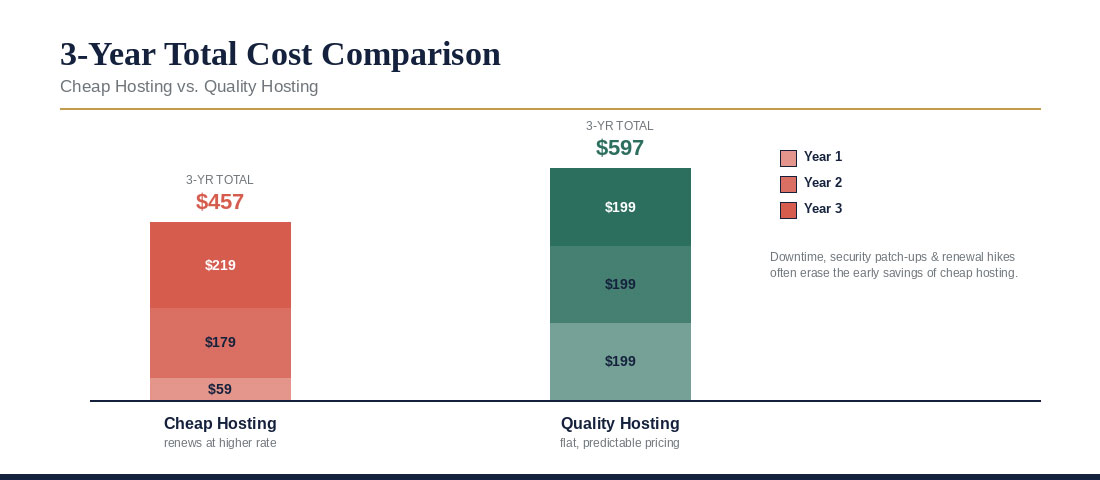
Migration typically costs $500-3,000 depending on site complexity, requires 30 minutes to several hours of downtime, carries genuine SEO risk from DNS propagation and potential broken redirects, and involves real work to verify everything transferred correctly. For businesses that could have started on quality hosting, this migration cost is entirely avoidable — but for businesses that started cheap and eventually needed to move, it’s an inevitable expense that offsets years of “savings”.
The timing of the migration is the specific problem. Businesses on cheap hosting migrate when the site’s problems become impossible to ignore — usually during periods of growth when traffic is increasing and the hosting is struggling. This means migration happens under pressure, with less time to plan properly, and with active revenue impact from the underlying performance problems the migration is meant to solve. Migration under pressure produces worse outcomes than planned migration would.
The frequency of migration for businesses that start cheap is often more than once. Cheap hosting to entry-tier VPS, then VPS to managed WordPress hosting, then perhaps managed to dedicated. Each migration has costs, downtime risks, and SEO risks. Businesses that skip the cheap phase entirely and start on hosting appropriate to their needs often migrate only once (or not at all) versus 2-4 times for businesses that chased the cheapest option each step.
Realistic three-year migration costs for businesses that started on cheap hosting typically add $1,500-5,000 to the total cost of ownership when done properly, on top of all the other hidden costs already accumulating.
The table below puts realistic numbers on the total cost picture across all seven hidden cost categories. These are typical ranges from what we see in client work rather than worst-case or best-case scenarios.
| Cost component (3 years) | Cheap hosting ($3-5/month) | Quality hosting ($30-50/month) |
|---|---|---|
| Direct hosting fees | $150 – $250 | $1,000 – $1,800 |
| Lost revenue from slow pages | $5,000 – $30,000+ | Minimal |
| Downtime cost | $1,800 – $7,200 | $150 – $600 |
| Security incident cleanup | $500 – $5,000+ (probability-weighted) | $0 – $500 |
| Support and problem-solving time | $1,500 – $5,000 (opportunity cost) | $300 – $800 |
| SEO ranking penalty impact | $10,000 – $50,000+ (compound revenue loss) | Minimal |
| External backup services (needed) | $300 – $1,000 | $0 (typically included) |
| Eventual migration cost | $1,500 – $5,000 | $0 (starting right) |
| Three-year total (typical business site) | $20,750 – $103,450+ | $1,450 – $3,700 |
The numbers speak for themselves. Yes, cheap hosting saves roughly $1,000-1,500 in direct fees over three years. No, this saving does not offset the $19,300-102,000+ in hidden costs that cheap hosting typically produces for real business sites. The invoice comparison is misleading because it measures the one dimension where cheap hosting wins while ignoring every dimension where it loses. Once the full cost picture is honest, quality hosting is dramatically cheaper across the full three-year window, and the “cheap” hosting reveals itself as one of the more expensive decisions businesses make about their web presence.
Marketing terms shift constantly. What used to be “shared hosting” is now sometimes called “starter”, “basic”, “affordable”, or even “business” (which is technically true — small businesses do use it). Recognising cheap hosting regardless of how it’s marketed matters because the technical characteristics are what produce the hidden costs, not the marketing label. Seven signals identify cheap hosting reliably.
Want Help Migrating From Cheap Hosting Without Losing SEO or Revenue?
If you’re on cheap hosting and want to move to something that doesn’t quietly cost you money, we handle hosting migration end-to-end — assessment, new hosting selection, migration with SEO preservation, testing, and post-migration monitoring. Most businesses see measurable performance and revenue improvements within weeks of moving to appropriate hosting.
The point of this article isn’t that cheap hosting is always wrong. Being honest about the specific contexts where cheap hosting produces adequate outcomes matters, because vague pro-quality-hosting advice produces bad decisions as often as vague pro-cheap advice does.
Cheap hosting is genuinely fine for personal websites and hobby projects. The stakes are low, revenue isn’t at issue, occasional slowness or downtime doesn’t have business impact, and the cost savings translate directly to affordability. If you’re building a personal blog, a family site, or a hobby project, cheap hosting is the correct choice — not because it’s ideal, but because the specific characteristics of cheap hosting fit the specific needs of these projects.
Cheap hosting works for very small business brochure sites where the site is essentially a business card. A local plumber whose business runs on phone calls and referrals, with a website that exists so people can find their contact information, isn’t underserved by cheap hosting. The hidden costs this article dissects mostly don’t apply when the site isn’t producing revenue and isn’t a critical business asset.
Cheap hosting works for learning environments and testing sites. Development sites, staging environments, sandboxes where you’re figuring out how things work — cheap hosting’s low cost and simplicity fit these use cases directly. Nobody’s business depends on these sites working reliably, so the hidden costs don’t materialise.
Cheap hosting works for very early stage businesses validating an idea. Before you know whether the business will work, over-investing in infrastructure is premature. Cheap hosting lets you launch cheaply, and if the business succeeds, migrating to appropriate hosting is straightforward. The failure mode of over-investment (spending on hosting for a business that doesn’t work out) is different from the failure mode of under-investment (paying hidden costs on a business that does work), but both are real.
For any of these contexts, cheap hosting is correct. The problem is not cheap hosting existing; it’s cheap hosting being chosen for revenue-generating business sites where the hidden costs quietly consume the visible savings. Match the tier to the actual requirement rather than picking the cheapest option and hoping.
The specific pricing tiers of quality hosting matter because they reframe the “quality is expensive” assumption that drives businesses toward cheap alternatives.
Entry-tier quality hosting: $15-30 per month. Quality VPS from providers like DigitalOcean, Vultr, Linode, or entry-tier managed hosting from providers like SiteGround, Cloudways, or WPX. Genuine dedicated resources, modern PHP, SSD storage, real support, and reliable uptime. For most small to mid-sized business sites, this tier is entirely sufficient.
Solid business hosting: $30-100 per month. Higher-tier VPS with more resources, or mid-tier managed WordPress hosting from providers like WP Engine, Kinsta, or Flywheel. Better performance, more sophisticated backup, priority support, and typically included CDN. For growing businesses with real traffic, this tier delivers consistently strong results.
Premium managed hosting: $100-300 per month. Higher tiers of WP Engine, Kinsta, Pantheon, or similar premium managed platforms. Enterprise-grade performance, comprehensive support, sophisticated developer tools, and reliability metrics that satisfy demanding businesses. For businesses where hosting reliability directly affects significant revenue, this tier is often warranted.
The math that makes quality hosting cheaper than cheap hosting over three years is straightforward once the hidden costs are included. Quality hosting at $30-50 per month costs $1,080-1,800 over three years in direct fees but avoids most or all of the $20,000+ in hidden costs cheap hosting produces. The difference of roughly $18,000-100,000 in avoided hidden costs makes quality hosting one of the highest-return infrastructure investments available to any business. Businesses running their sites on properly-hosted WordPress development from the start rarely encounter the cascade of problems that cheap hosting produces, and the compound benefit over years is significant.
For businesses currently on cheap hosting, migration is genuinely important but needs to be done properly to avoid making the situation worse temporarily. Five steps produce reliable migration.
Step one: choose the destination hosting before starting migration. Assess your requirements, pick a specific host and tier that fits, and sign up for the account before touching anything on the current hosting. Rushed hosting decisions during pressure produce their own mistakes.
Step two: set up the site on the new hosting as a staging environment. Copy the site to the new host, configure it exactly as production would need to be configured, and test it thoroughly on the new infrastructure. This should include speed testing, functional testing of all key features, and verification that all integrations work correctly. Do this while the site is still live on the old hosting.
Step three: verify the staging environment thoroughly. Run PageSpeed Insights on the staged version to confirm expected performance improvements. Test the checkout, contact forms, and any custom functionality. Have someone else review the site for anything that looks wrong. Don’t move forward until the staged version is genuinely ready.
Step four: execute the DNS switch during low-traffic hours. Point your DNS from the old hosting to the new hosting. Monitor traffic patterns during propagation (typically 30 minutes to a few hours). Keep both hosting accounts active until DNS propagation completes and you’re confident everything transferred correctly.
Step five: verify post-migration and monitor for issues. Confirm the site is loading correctly from multiple locations. Verify Google Search Console for any errors. Watch for any 404s or broken redirects. Keep the old hosting active for at least 30 days as fallback. Update Google Search Console with the new server information if the hosting provider requires it.
Proper migration executed this way typically produces minutes of downtime (during DNS propagation) rather than hours or days, and preserves SEO through the transition rather than damaging it. Rushed or unstructured migrations produce the failures that give hosting migration its bad reputation.
If your current situation matches the signals below, you’re already paying the hidden costs discussed above and the migration to quality hosting will produce measurable improvements.
One specific cheap hosting practice worth calling out is the introductory-rate model that dominates the market. Understanding it changes how you evaluate hosting pricing.
The pattern works like this. Marketing prominently displays a $2.99 per month rate. Buried in the terms, this rate applies only for the first year (sometimes three years), after which the price rises to $12.99-16.99 per month. Renewal rates are 4-6x the promotional rate, and the promotional rate is typically only available for new customers on longer-term prepayment.
The mathematics over three years look very different from the promotional pricing. A “$2.99 per month” plan actually costs $2.99 per month for year 1 ($36 total) plus $12.99+ per month for years 2-3 ($312+ total) — realistic three-year cost of $350-400 rather than the $108 the promotional rate might suggest. This is still cheaper than quality hosting on the invoice, but the “cheap” is significantly less cheap than the marketing implies.
Some cheap hosts also introduce fees over time that weren’t part of the initial pricing — backup fees, SSL fees (even though SSL is genuinely free through Let’s Encrypt), migration fees, upgrade fees, and various add-ons. The total effective cost over three years often exceeds what quality hosting would have cost without any of the hidden costs discussed above.
The industry-standard response when businesses discover this pricing pattern is annoyance rather than migration — most customers stay because switching feels like more effort than accepting the higher rate. This produces the specific customer economics cheap hosting relies on: acquire cheaply with promotional pricing, retain through inertia after raising rates. The rational response for businesses actually paying attention is to migrate at renewal rather than accept the increase, but this requires the effort most businesses don’t invest.
For most business websites, the migration to quality hosting is manageable independently if approached methodically. There are situations where professional help produces meaningfully better outcomes.
Bring in help when the site is generating significant revenue and the migration risk needs to be minimised. Bring in help when the site is technically complex and the migration involves database schema, custom code, or integrations that could break during transfer. Bring in help when you don’t have the internal capacity to manage the migration project alongside running the business. Bring in help when you’re not confident about which quality hosting tier fits your specific needs and want an assessment before committing.
For ongoing hosting management alongside broader website care, structured maintenance produces meaningfully better outcomes than reactive intervention. Hosting configuration decays quietly without attention — plugin conflicts appear, performance drifts, security patches need applying, backups need verifying. Ongoing management catches these before they become user-visible problems. The full picture of infrastructure and application-layer care is what our website maintenance services are built around. For businesses running the underlying custom website development we deliver, hosting is set up correctly from the start and maintained systematically after — which is exactly what avoids the accumulation of hidden costs cheap hosting produces. For businesses currently on cheap hosting weighing the specific next step, the tier decision is covered in detail in our shared vs VPS vs dedicated hosting comparison.
The honest summary of the cheap hosting question is that the $3-per-month plan looks like a bargain and is genuinely one of the most expensive infrastructure decisions a business can make once you honestly count the total picture. The visible savings of $300-500 per year get consumed many times over by the hidden costs — lost revenue from slow pages, downtime that costs money, security incidents and cleanup, wasted time fighting problems, SEO penalties that compound over years, backup gaps that turn into disasters, and the eventual migration that businesses defer until they can’t. Once these are honestly totalled, quality hosting at $30-50 per month is dramatically cheaper across the three-year window that matters for any serious business site. The specific businesses for whom cheap hosting is genuinely correct — personal projects, hobby sites, business-card brochure sites, and idea validation MVPs — are a real category, but they’re a smaller category than the cheap hosting market suggests. For revenue-generating business sites, the correct answer is almost always quality hosting appropriate to the actual requirement, and the sooner in the site’s life you make that decision, the more of the compound value you capture. The businesses that navigate this well are the ones treating hosting as strategic infrastructure rather than as an expense to minimise, and the compound benefit over years is exactly the compound damage cheap hosting would have produced going in the other direction.
| Is cheap hosting really that bad? | For personal projects, hobby sites, and business-card brochure sites, cheap hosting is genuinely fine and the honest answer is that it’s the correct choice for these contexts. For revenue-generating business sites, cheap hosting produces significant hidden costs that dwarf the visible savings — lost revenue from slow pages, downtime that costs money, security incidents, wasted time, SEO ranking penalties, backup gaps, and eventual migration. Total three-year cost including these hidden factors typically exceeds quality hosting cost by 2-3x for real business sites, making cheap hosting one of the more expensive infrastructure decisions businesses make even though the invoice looks cheaper. The right frame is matching the hosting tier to the site’s actual purpose rather than optimising for the visible price alone. |
| How much should I actually pay for hosting? | For most business websites, $15-50 per month gets you genuinely quality hosting that doesn’t produce the hidden costs discussed in this article. Entry-tier options include quality VPS from DigitalOcean, Vultr, or Linode at $15-30 per month, or entry-tier managed hosting from SiteGround, Cloudways, or WPX at $20-40. For sites with real traffic (thousands of monthly visitors), $30-100 per month for managed WordPress hosting from WP Engine, Kinsta, or Flywheel is a reasonable range. For enterprise sites and high-traffic operations, $100-300 per month for premium managed hosting or well-configured cloud infrastructure is often warranted. The right frame is “what does the site actually need to work well?” rather than “what’s the cheapest option?”, and the answer to the first question typically produces lower total cost over three years than the answer to the second. |
| What’s the hidden cost of shared hosting specifically? | Shared hosting produces seven categories of hidden cost. Lost revenue from slow pages (typically $5,000-30,000 over three years for revenue-generating sites). Downtime cost from realistic 99.5% uptime versus advertised 99.9% ($1,800-7,200 typical). Security incident cleanup from shared IP reputation and neighbour compromise ($500-5,000+ probability-weighted). Time cost from slow support and manual workarounds ($1,500-5,000 opportunity cost). SEO ranking penalties from poor Core Web Vitals and slow server response ($10,000-50,000+ compound revenue loss). External backup services needed to fill gaps in host-provided backups ($300-1,000 over three years). Eventual migration when the site outgrows shared hosting ($1,500-5,000). Total hidden cost over three years typically ranges from $20,000 to over $100,000 for real business sites, dwarfing the $1,000-1,500 saved in direct fees. |
| Can I run a business on $5-per-month hosting? | Technically yes, and many businesses do — but with significant performance, reliability, and hidden cost consequences. Very small businesses where the website is essentially a business card supplementing revenue generated through other channels can operate on cheap hosting without meaningful impact, because the hidden costs don’t materialise when the site isn’t producing revenue. For businesses where the website is revenue-generating infrastructure (eCommerce, lead generation, service bookings), $5-per-month hosting quietly costs significantly more than $30-per-month hosting once the total picture is honestly counted. The right question is not “can I get away with cheap hosting?” but “what’s the true total cost of cheap hosting for my specific business over three years?” — and for revenue sites, the answer usually favours quality hosting substantially. |
| How do I know if I’m currently on cheap hosting? | Seven signals identify cheap hosting regardless of how it’s marketed. Sub-$5 per month pricing (especially with promotional introductory rates that renew much higher). “Unlimited” everything claims in the marketing. Old PHP versions available (7.x when 8.2+ is current). Shared IP with no dedicated option or expensive dedicated add-on. HDD storage rather than SSD or NVMe. Support only through chatbots or ticket queues that take 24-48 hours to respond. No server-level caching options like Redis or Varnish. If your current hosting matches most of these signals, you’re on cheap infrastructure regardless of the marketing terminology used. The other reliable signals are the symptoms — intermittent slowness, mysterious brief outages, poor Core Web Vitals that won’t improve, and support experiences that consume days rather than hours. |
| Is it worth switching from cheap hosting? | For revenue-generating business sites, yes — usually the migration pays back within a few months through recovered revenue and reduced hidden costs. Sites that measure conversion rates typically see 10-20% conversion improvements within weeks of moving to quality hosting purely from the speed improvement. Sites tracking organic traffic often see meaningful ranking recoveries within 60-90 days as Core Web Vitals move from Poor to Good. Sites with any transactional element see reduced downtime and stronger reliability that translates directly to revenue. The typical business site that has been on cheap hosting for two or more years usually finds the migration paying back within the first year purely through recovered performance and revenue, before counting the compound benefits over years. For personal or hobby sites without business dependence, the migration isn’t worth the effort — cheap hosting is genuinely fine for these contexts. |
| What happens if I just stay on cheap hosting long-term? | The hidden costs continue accumulating and compound over time. Lost revenue from slow pages compounds because you never capture the visitors your slow site drives away. SEO ranking losses compound because lower rankings produce less traffic which produces fewer engagement signals which produces further ranking losses. Security incidents become more likely as the shared infrastructure ages and neighbour compromises accumulate. Support quality typically degrades over time as cheap hosts consolidate customers onto older infrastructure. Backup reliability quietly erodes. The pattern most businesses see is not sudden crisis but gradual decline — the site quietly performs worse each year, produces less revenue than it could, and requires more effort to keep functioning. Eventually the business either migrates (usually under pressure at a bad time) or accepts significantly worse outcomes than the site could produce. Neither outcome is good, and both are avoidable by not choosing cheap hosting for a real business site in the first place. |
Ready to Stop Paying the Hidden Costs of Cheap Hosting?
We assess your current hosting situation, quantify the hidden costs you’re likely already paying, recommend the right destination hosting for your specific business, and handle the migration end-to-end with SEO preservation and downtime minimisation. With 14+ years of experience and 550+ clients served, we know what quality hosting looks like versus what just markets itself that way. Send us your site URL and we’ll respond within one business day with an honest read on what your current hosting is actually costing you.
Whether you have a new idea, a business challenge, or something you would like to improve, we are here to help. From building websites, online stores, CRM systems, and custom applications to exploring AI solutions, improving SEO, or growing your sales, simply tell us what you have in mind, and we will help you find the best way forward.
A member of our team will review your enquiry and respond to you shortly.